
When the Runway Goes Green: Fashion's Ongoing Obsession with Plants
There is a pattern that keeps repeating on runways, in editorials, in the quiet decisions of art directors, set designers and embroiderers working late in ateliers. Plants keep appearing. Not as background, not as decoration, but as the main point — as something the clothes are in conversation with.
It is worth asking why. Not to be cynical about it, but because the answer reveals something genuine about what nature means to the people creating these collections, and what we are all, collectively, still reaching for.
The obsession is not new. It is cyclical
In Victorian England, the cultural fixation on ferns reached a pitch that doctors eventually named: pteridomania, or fern fever. People collected them obsessively, catalogued them, built elaborate cases to display them, and then, almost inevitably, transferred their desire onto everything around them. Fern fronds appeared on textiles, glass, iron fences, fireplace gates, and women's clothing. The plant had moved from the garden into the wardrobe, and in doing so, it carried something of its original quality with it. A fern print on a Victorian dress was not just decoration. It was a way of staying close to something the wearer found beautiful and wanted to keep near.
The monstera followed the same arc more recently. What began as a mid-century interior staple became a full cultural icon — appearing on bags, wallpaper, hotel lobbies, and clothing — because something about its form, its graphic confidence, its particular shade of deep tropical green, kept speaking to people.
This is the pattern: the more urban and indoor our lives become, the more plants appear on what we wear. It is not cynical. It is just human — a way of keeping something close when the original is far away.
What the runway is actually reaching for
Nature has always been one of fashion's deepest sources of inspiration. TThe references are everywhere once you start looking: the geometry of a leaf translated into a cut and the gradient of a dying plant in autumn that somehow becomes a dye palette. Designers return to botanical forms not because they are fashionable but because they are formally inexhaustible. Every season offers different light, different growth, different material to work with.
Spring 2025 felt like a moment when this long relationship became particularly explicit. Loewe referenced Victorian-era botanical promenades — the same cultural moment that produced fern fever — while Miu Miu showed naturalistic embroideries so precise they looked drawn from a floriculture textbook rather than a trend forecast. For S/S 2026, houses like Erdem, Dior, and Chanel are returning to botanical and bird motifs on silk and brocade, described in press as ethereal and whimsical, resistant to any reading of them as merely decorative.
The language around the clothes is doing something interesting: it keeps insisting that the plants are more than surface. The turn toward embroidery, toward handwork, toward motifs that require time and skill to produce, suggests that what fashion is reaching for is not just the image of a plant but the quality of one. Patience. Slowness. The sense that something took a long time to become what it is. These are values that nature embodies effortlessly, and that craft — in fashion as in ceramics, in weaving, in work done slowly by hand — tries to honor.
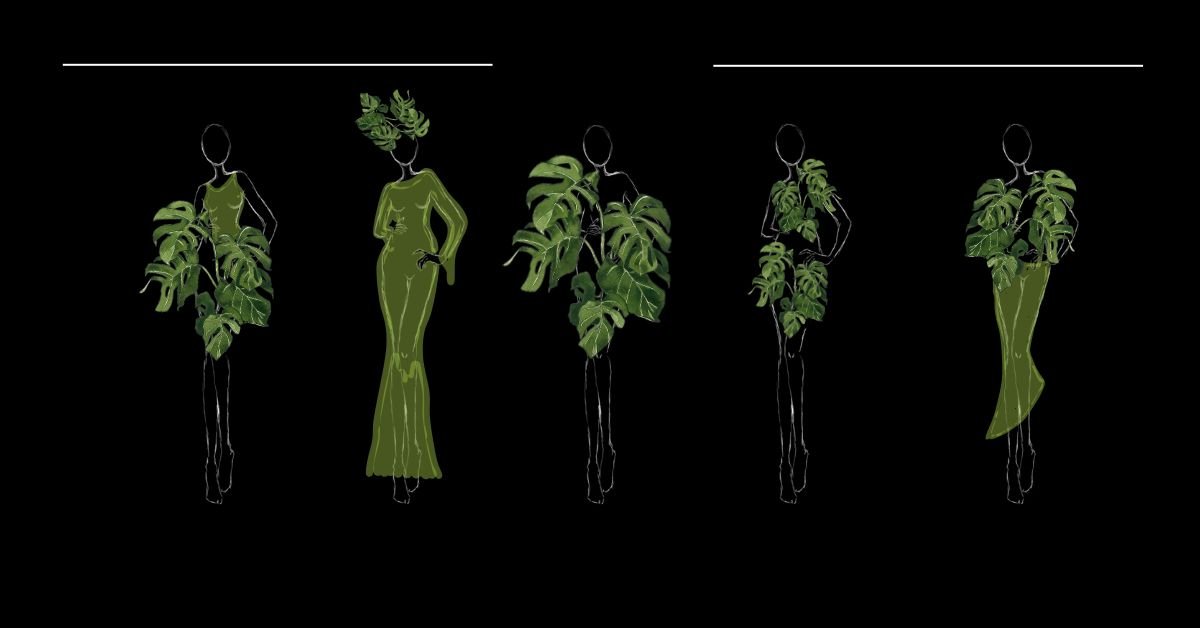
When fashion tries to close the gap entirely
Sometimes inspiration is not enough, and designers attempt something more radical — not representing nature but literally incorporating it. For Loewe's Spring/Summer 2023 menswear collection, Jonathan Anderson collaborated with bio-designer Paula Ulargui Escalona to send models down the runway wearing clothing from which actual blades of grass sprouted, shoes that shed chia leaves with every step, sweatpants so sodden with living matter they seemed to belong to the earth rather than a wardrobe.
Escalona had grown oat grass, chia, wheatgrass, and ryegrass on denim and cotton over twenty days in a polytunnel greenhouse. She described the intention simply: "The main focus of the project was to reconnect humans with nature by feeling the moisture, the texture, and the life. I wanted to show that the fashion industry could be as sustainable as nature itself." She also spoke honestly about the process — how the space, the light, the specific fabric, the seeds themselves could all interfere or redirect the outcome in ways that were, as she put it, "sometimes super confusing." Her advice was not a formula but a disposition: understand what the plants need, and make that connection. You cannot force the growth. You can only create the conditions for it.
The two sides of the coin
It would be incomplete not to name the tension that exists alongside all of this. Fashion has a well-documented habit of borrowing the aesthetics of values it does not always fully embody. Brands that fill runway sets with thousands of ferns and grasses, that speak about their collections in the language of ecology and slowness, sometimes operate supply chains that tell a more complicated story. The gap between botanical imagery and genuine sustainability practice can be wide.
We say this as a brand that also operates within design and commerce, that also makes and sells objects, and that also has to reckon with what it means to bring nature into a market. The tension is not fashion's alone. It belongs to anyone who works at the intersection of living systems and designed ones.
But the cynical reading is not the only one available, and it is not necessarily the most accurate. Garden designers and historians who work with fashion houses argue that the intersection is genuinely valuable — that it opens real conversations, shifts attention, and can signal movement toward different ways of making and consuming, even if slowly. Intention matters, even when it is not yet fully matched by practice.
What feels honest is to hold both readings at once: to recognise the genuine love of nature that runs through this work, and to notice when that love stops at the image. A moss-covered runway is not a changed supply chain. But it might be the beginning of wanting one.
What this means from where we stand
At Dirty Roots, we think about this a lot — about what it means to bring nature into designed space without flattening it into decoration.
The honest answer to what we do differently is simple: the plant in our world is not a print. It is not a set. It is not a motif on silk that gets archived at the end of the season. It is a living organism sitting in your home, responding to your light, growing on its own schedule, largely indifferent to how much you fuss over it.
Fashion keeps returning to plants because it wants what they have — that quality of being genuinely, stubbornly alive. We think the only way to actually have it is to grow one.
Sources:
Dezeen
Refinery29
Who What Wear
Marie Claire
Costa Farms
