
What Grows in Your Bathroom Cabinet: The Plant Origins of Skincare
Open a bathroom cabinet and you'll find a dense ecosystem of names: hyaluronic acid, niacinamide, tocopherol, salicylic acid. It reads like a lab inventory. What's easy to miss is where most of these substances come from: a plant. A specific plant, with a specific biology, that developed these compounds over millions of years of adaptation before anyone thought to put them in a bottle.
Modern skincare is saturated with plant material. What's changed over time is visibility. Plants have been refined into compounds, compounds translated into acronyms, and somewhere along that chain the organism itself, the thing that grew, adapted, defended itself, and interacted with its environment, becomes harder to see. Tracing ingredients back to their botanical origins makes skincare more legible, and the plants themselves considerably more interesting.
A Much Older Relationship Than the Industry Around It
Long before formulations and branding, plants were used directly on skin because they worked in observable ways and the record of that is remarkably consistent across cultures and centuries.
Ancient Egyptian papyri, including the Ebers Papyrus dating to around 1550 BCE, describe preparations using castor oil, aloe, and fenugreek for skin protection, wound healing, and inflammation. These were practical responses to what plants visibly did: reduced swelling, kept wounds from becoming infected, helped damaged tissue repair itself.
Greek and Roman medical writers, such as Dioscorides, Galen, Pliny the Elder, catalogued hundreds of plant preparations for skin conditions, many of which remained in continuous use through medieval and early modern Europe. The same species appear repeatedly across these traditions not because of cultural borrowing, but because the observations kept pointing to the same plants.
What these traditions were recording, without the vocabulary to fully explain it, was plant biochemistry. Plants produce complex chemical compounds primarily for their own survival: to defend against pathogens, repair damage, protect against UV radiation, retain water in dry conditions. Many of these same compounds turn out to be remarkably compatible with human skin biology, because the underlying cellular mechanisms involved in tissue protection and repair are shared across a very wide range of living organisms. What's now packaged as an "active ingredient" was, for most of human history, simply part of a plant.
What These Plants Actually Do
Some of the most common skincare ingredients still map cleanly back to specific species. Understanding the plant behind the ingredient and the biological reason the compound exists gives a clearer picture of what it actually does on skin.
Aloe vera produces a gel in its inner leaf tissue composed largely of polysaccharides, these are long-chain sugar molecules, of which the most studied is acemannan. Polysaccharides form a film on the skin surface that slows water loss, and acemannan in particular has been shown to support wound healing by stimulating cell proliferation and modulating the immune response at the site of damage. The plant produces this gel to store water and protect its own internal tissue in arid conditions. Its effects on human skin in cases of burns, irritation, and dehydration are among the most consistently documented in botanical skincare research (Surjushe et al., 2008).
Calendula (Calendula officinalis) contains triterpenoids, a class of compounds built from repeating carbon units, which plants use in their own membrane structure and as part of their chemical defense, alongside flavonoids, plant pigments that also function as antioxidants and anti-inflammatory agents. Together these compounds have been shown to accelerate tissue repair and reduce inflammatory responses in damaged skin (Preethi & Kuttan, 2009). Calendula has been used in wound care preparations continuously since at least the medieval period.
Turmeric (Curcuma longa) produces curcumin, a polyphenol, a category of compounds characterized by multiple phenol rings in their molecular structure, found widely across the plant kingdom and associated with antioxidant activity. Curcumin specifically modulates several inflammatory signaling pathways in the body, making it relevant to skin conditions driven by chronic inflammation, including psoriasis and acne. Research into its topical application is ongoing, and its limitations, including low skin penetration in its unmodified form, are part of what makes formulation around it technically interesting (Vollono et al., 2019).
Chamomile (Matricaria chamomilla) contains bisabolol, a terpene alcohol (part of a large class of aromatic compounds that plants produce for a range of defensive and structural purposes) and chamazulene, a compound that forms during the steam distillation of chamomile essential oil and gives it its characteristic blue color. Both are associated with calming irritated skin and reducing redness, and chamomile preparations have a long documented use in treating inflammatory skin conditions.
Rosehip (Rosa canina) is particularly valued for two things: its concentration of vitamin C, which supports collagen synthesis in the skin, and its fatty acid profile, specifically the presence of linoleic acid and trans-retinoic acid, which support skin barrier function and cell turnover. Rosehip oil is one of the plant-derived ingredients whose mechanisms are well understood, which is part of why it has moved from traditional use into evidence-based cosmetic formulation.
Whole Plant vs. Isolated Compound
Once a plant enters industrial processing, it gets simplified and that simplification involves genuine trade-offs worth understanding.
An isolated compound offers precision. The concentration of vitamin C in a formulated serum can be controlled to a specific percentage, its stability can be managed, and its effects on the skin can be measured under consistent conditions. This is genuinely useful, especially for conditions that respond to particular compounds at particular concentrations.
What isolation removes is complexity. Plants don't produce single compounds independently, they produce networks of interacting chemicals. Flavonoids, terpenes, and phenolic acids often work together, sometimes amplifying each other's effects, sometimes buffering potential irritants. This is sometimes called the entourage effect in botanical research: the idea that the sum of a plant's chemistry can behave differently from its isolated parts.
Using a whole plant extract typically means lower and less consistent potency, but potentially broader activity across multiple biological pathways. Using an isolated compound means higher specificity and more predictable results, but a narrower range of function. Understanding this distinction helps explain why the same plant can appear in both a traditional remedy and a high-precision serum, it's functioning differently in each context, and both can be valid.
Using Plants Directly: What Holds Up
There's a longstanding interest in using raw plants directly on skin and the results vary considerably depending on the plant, the preparation, and the intended effect.
Fresh aloe gel applied to minor burns or irritation is one of the clearest cases where minimal processing still delivers close to the studied benefits. The polysaccharides are present in the fresh gel in meaningful concentrations, and the skin response is consistent with clinical findings.
Chamomile infusions can soothe mild irritation, though the concentration of active compounds is lower than in a standardized extract. Calendula prepared as an oil infusion, that is dried flowers steeped in a carrier oil for several weeks, can support dry or inflamed skin, particularly if the preparation is given adequate time.
Some compounds, however, require processing to become stable or bioavailable enough to act effectively. Curcumin has low skin penetration in its natural form and degrades quickly on exposure to light and heat, which is why effective topical formulations typically use modified or encapsulated versions. Vitamin C in rosehip is genuinely present, but at concentrations lower than in formulated serums specifically designed for stability and penetration.
Plants also produce irritants and allergens alongside their beneficial compounds. Essential oils in particular can cause sensitization with repeated direct application. The practical picture is one of specificity: some plants, in some preparations, deliver real effects directly. Others work better when their active compounds have been extracted, concentrated, or stabilized.
Ethnobotany: Where Traditional Knowledge Meets Research
A growing field of research is now working to formally study traditional plant knowledge and what it finds is that the overlap between historical use and biochemical evidence is often striking.
Ethnobotany, the study of how different cultures have used plants across time, has become a methodologically serious discipline that serves as a bridge between observed traditional practice and laboratory validation. Studies systematically comparing plants used in traditional medicine systems with their documented pharmacological activity consistently find that empirical observation, accumulated over generations, identified effective species long before their chemical profiles were understood (Albuquerque et al., 2013).
This matters for skincare specifically because many of the plants currently used in cosmetic formulations appear in traditional systems across multiple unconnected cultures. The convergence is telling. It suggests that the effects were observable enough, and consistent enough, to be recorded and transmitted across very different knowledge traditions. The science that explains why they work came much later. The observation that they worked came first.
Back to the Plant
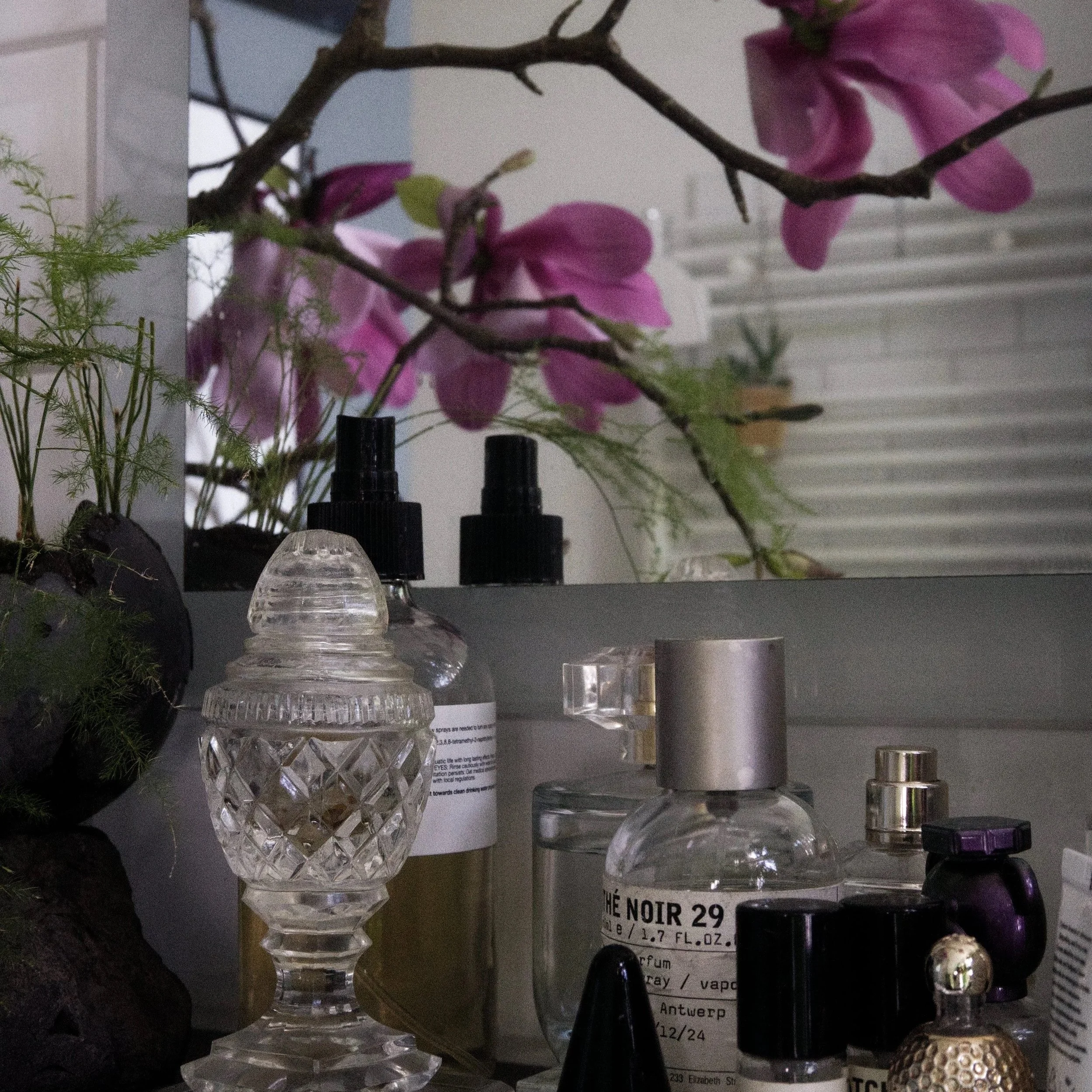
Looking at skincare through the lens of its botanical origins doesn't make it simpler. It makes it more layered and considerably more interesting.
Aloe retains water in skin because it retains water in its own tissue to survive in desert conditions. Calendula modulates inflammation because it needs to repair its own physical damage. Turmeric produces curcumin as part of a chemical defense system that happens to interact productively with human inflammatory pathways.
These are biological functions that developed over evolutionary timescales and that humans have been observing, using, and gradually understanding for thousands of years. The industry around these plants is relatively recent. The plants, and the knowledge of what they do, are not.
Once the ingredients in a bathroom cabinet start to look like fragments of specific living systems rather than a list of functions, the cabinet looks different and so does the broader conversation about what we put on our skin, where it comes from, and why it works.
Sources
Surjushe, A., Vasani, R., & Saple, D. G. (2008). Aloe vera: a short review. Indian Journal of Dermatology. https://www.ncbi.nlm.nih.gov/pmc/articles/PMC2763764/Preethi, K. C., & Kuttan, R. (2009). Wound healing activity of flower extract of Calendula officinalis. https://pubmed.ncbi.nlm.nih.gov/23341914/Vollono, L. et al. (2019). Potential of Curcumin in Skin Disorders. https://www.ncbi.nlm.nih.gov/pmc/articles/PMC5490550/