
Rooted in Time: The Human Impulse to Contain and Display Plants
From the earliest traces of human expression, people have felt compelled to depict and deliberately position plants within their surroundings. Rather than serving merely as background or ornament, vegetal forms have been treated as intentional subjects: represented, isolated, and often placed within defined settings where they could be observed and contemplated. The impulse to reproduce plant life and to assign it a fixed place within a constructed environment is so ancient and so consistent that it cannot be explained merely as an aesthetic tendency. It reflects something more deeply rooted in the human experience, a logic that has persisted, almost unchanged, throughout every era we have documented.
Where the Dialogue Began: Marks on Stone
The most famous cave paintings, Lascaux, Altamira, Chauvet, are known for their animals: bison, horses, deer, figures in motion captured by hands that understood what they were observing. Yet alongside these, and far less discussed, are vegetal elements: handprints bordered by leaf-like shapes, marks resembling branches, motifs that follow the logic of a growing plant. These are not merely naturalistic representations, but rather an act of recognition: the trace of an impulse to include vegetal forms in the visual record of human life.
What is significant is the presence of these images, rather than their botanical precision. Human beings living in entirely natural environments, surrounded by plants at every moment of the day, still chose to represent them, because something in the relationship between humans and plants seemed to require being fixed, held still, made visible in a way that mere presence could not guarantee.
That is the earliest documentation we have of this impulse. It has never disappeared.
Sacred Botanics: When Plants Became Essential
In Egypt and Mesopotamia, the plant ceases to be merely represented and becomes obligatory. The lotus and the papyrus are structural elements appearing in every context in Egyptian iconography, from temples to jewelry, from funerary frescoes to the capitals of columns. The lotiform column, whose capital imitates the calyx of the lotus flower, is among the most widespread architectural elements of antiquity. It is impossible to construct a sacred space without it.
Egyptian civilization did not simply appreciate vegetal forms: it required them. The plant had to be present, physically, as an offering in funerary rites, and visually, as a form repeated to exhaustion across every available surface.
In Mesopotamia, the so-called Tree of Life, a stylized vegetal form flanked by winged figures, appears on reliefs, cylinder seals, textiles, and ceremonial objects across millennia and cultures. It is a form that every civilization in the region felt compelled to reproduce, adapt, and transmit, shaping the concept of plants as an organizing principle and not merely as ornament.
The First Act of Staging Nature
The Greeks and Romans did something specific that deserves closer attention: they invented the object whose sole purpose is to contain a living plant and present it as an aesthetic choice.
The Roman garden is a designed environment with pathways, fountains, statues, and pergolas, in which plants are cultivated and arranged according to principles more closely related to visual composition than to harvest. At the center of this environment stands the terracotta pot: an object created specifically to contain soil and roots, to give a plant a place that is not the natural ground, to bring it into a constructed space and declare it part of the furnishing.
This is the direct origin of what we do today, not only metaphorically, but as a historical fact. The flowerpot, as an object with an aesthetic function distinct from agriculture, emerges at this moment. Greco-Roman civilization recognized that a plant in a container is fundamentally different from a plant in the soil, and that this difference was worth pursuing, designing, and refining.
It is worth pausing on this point, because it represents a genuine turning point. Before this moment, plants were cultivated, venerated, and represented. After it, they were also staged, placed in purpose-built containers, positioned within interior or transitional spaces, and treated as objects capable of transforming an environment simply through their presence.
Evidence of this shift can be found in the peristyle gardens of the Roman houses in Pompeii, such as the House of the Vettii, where potted plants and carefully arranged greenery formed part of the domestic scenography. Similar practices appeared in sacred contexts, including the courtyards of temples such asTemple of Isis, where vegetation contributed to the ritual atmosphere. Literary descriptions of villas such as Hadrian's Villa further attest to the deliberate placement of plants within architecturally designed settings, integrating nature into spaces intended for contemplation, leisure, and display.
Freezing Life: Art and Science in Bloom
In seventeenth-century Holland, two seemingly different phenomena occurred simultaneously, yet they share the same root.
The first is botanical still life. Flemish and Dutch painters, such as Jan Brueghel the Elder, Rachel Ruysch, Jan Davidsz. de Heem, created floral compositions of extraordinary technical complexity: impossible bouquets in which flowers from different seasons coexist within a single vase, insects resting on petals, droplets of water along the edges of leaves. These works are artificial constructions in which plants that never existed together at the same time are held still by painting, achieving a perfection that nature does not allow.
The second is scientific botanical illustration. Maria Sibylla Merian, Georg Dionysius Ehret, and the illustrators of the great botanical encyclopedias of the period were engaged in the same challenge: how to represent a plant with sufficient precision to make it recognizable, classifiable, and transmissible. How to hold still something that grows, changes, and withers.
These two traditions may appear opposed, one being art, the other science, but the underlying impulse is identical. Both attempt to resolve the same fundamental problem: the plant does not remain still. It is alive, and life changes. Painting and scientific drawing are two different responses to the impossibility of this immobility, two ways of saying: this flower, at this moment, had this form and I want it to remain so.
Modernism and the Unruly Leaf
Twentieth-century modernism has a particular relationship with plants, one worth observing closely.
Architects and designers of the modern movement were obsessed with the purity of form: the straight line, the flat surface, the elimination of ornament. Architects such as Mies van der Rohe, Le Corbusier, and Alvar Aalto created designs in which every element is controlled and every proportion calculated. Yet in these same archival photographs, within these meticulously designed interiors, plants invariably appear. A ficus in a corner. A branch in a cylindrical vase on a table. A composition of leaves on a shelf.
This is not an accidental contradiction. It is a tension that modernism never fully resolves, because it is inherently irresolvable. The plant is the element that refuses to conform to the design: it grows in unforeseen directions, changes with the seasons, and occupies space according to its own logic. In an environment designed for total control, the plant is the only element that reminds us that not everything is controllable.
Modern architects understood this. And it is likely why they included plants, not despite the tension, but because of it. The plant within the modernist interior is the exception that proves the rule, the point at which the design acknowledges its own limits and transforms them into something meaningful.
A Line Through Time: From Antiquity to Dirty Roots
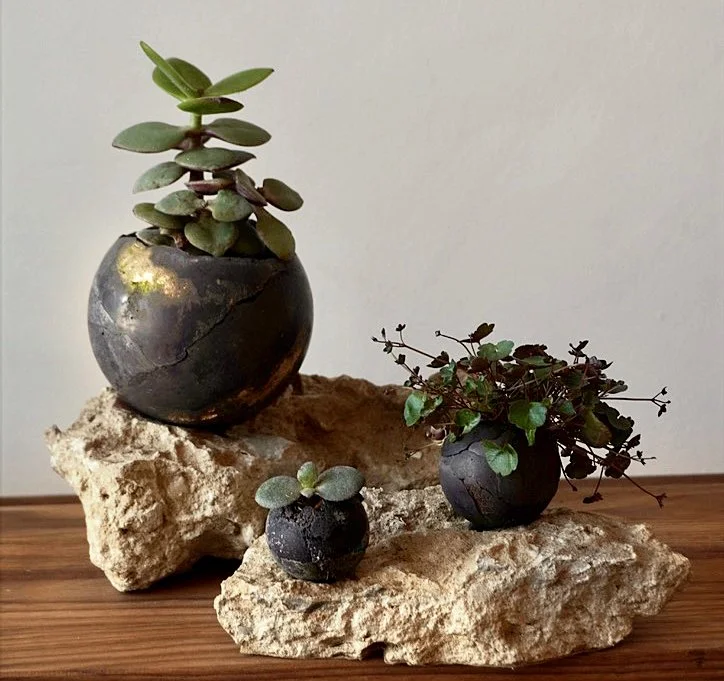
The spherical vases developed by Dirty Roots Berlin do not emerge in isolation. They belong to a lineage that stretches across millennia. Rather than representing a rupture with the past, these forms reinterpret an enduring tradition, translating it into a contemporary language of material and proportion.
This line passes through Roman terracotta, the Han dynasty vessels in which ornamental plants were cultivated, the maiolica vases of the Italian Renaissance, the porcelain containers of the great European manufactories of the eighteenth century, the cast-iron planters of the nineteenth century, and the minimalist ceramic pots of the twentieth. Every era has found its own form for containing a living plant and presenting it as a deliberate choice, and each form reflects something specific about the culture that produced it.
What remains unchanged throughout these variations is the underlying logic: something within us requires giving plants a place that is not the natural ground, bringing them into the spaces we inhabit, and constructing an object whose sole purpose is to host and display them. This reflects a need related to the presence of the living within a built environment, to the desire to keep vegetal forms close even when it is not necessary to do so.
Cave paintings, lotiform columns, Roman gardens, Flemish still lifes, and plants in modernist interiors are all attempts to respond to the same impulse, using the means available to each era. The spherical concrete vase is our attempt. The logic behind it is as ancient as anything we have ever done.
