
Underfoot and Overlooked: The Quiet Work of Moss
There is a plant that has been growing on this planet for approximately 450 million years. It was here before flowering plants, before trees, before anything resembling the landscapes we now think of as natural. It covered the first bare rock that ever became soil. It is still doing that, quietly, on every surface that stays damp long enough to let it.
Most people step over it.
Moss belongs to a group called bryophytes, that are non-vascular plants, meaning they have no internal system for transporting water, no roots in the biological sense, no flowers, no seeds. Everything happens at the surface. Moss absorbs water and nutrients directly through its leaves, which makes it structurally one of the simplest land plants that exists. That simplicity is also what has made it one of the most durable: the same basic form that appears in the fossil record 450 million years ago is recognizable in the moss growing on a Berlin wall today. While the rest of the plant kingdom evolved steadily toward complexity through vascular systems, flowers, fruit and elaborate reproductive strategies, moss stayed largely as it was, and kept working.
Water, at a Scale That Matters
The most important thing moss does is hold water and the scale at which it does this is difficult to overstate.
Sphagnum moss, the genus most associated with peatlands and bogs, can absorb and retain up to twenty times its own dry weight in water. The mechanism is structural: sphagnum leaves contain large dead cells, called hyaline cells, that fill with water like tiny reservoirs. A living mat of sphagnum moss is essentially a sponge at landscape scale. It saturates with rainfall, holds it and releases it gradually over time.
Across a forest floor, a hillside, or a peatland, this capacity becomes a hydrological system. Moss slows the movement of water through a landscape, buffers flooding during heavy rainfall by absorbing large volumes quickly, maintains local humidity during dry periods by releasing water slowly, and regulates the moisture available to the plants growing alongside and above it. In watersheds where moss cover is dense, stream flow is measurably more consistent across seasons than in watersheds without it. The moss is not incidental to the water cycle of these systems. It is a functioning part of it.
The most extreme expression of this is the peatland. Peatlands are ecosystems built on thousands of years of sphagnum accumulation. These layers of partially decomposed moss compressed over millennia into peat cover approximately three percent of the earth's land surface, which sounds modest until you consider what that area contains: roughly one third of all the carbon stored in soil globally. A single peatland can hold more carbon per hectare than a tropical rainforest.
Building the Ground Floor
Moss is what ecologists call a pioneer species. It goes first, into conditions where almost nothing else can yet survive.
Bare rock, freshly exposed soil, the surface of concrete, the north face of a roof. These are environments with no organic matter, no established soil structure, and no established plant community. Moss can colonize them. It does this through a combination of tolerance for desiccation, meaning it can dry out almost completely and rehydrate when water returns, resuming normal function within hours, an ability to extract minerals directly from rock surfaces through chemical secretion, and a capacity to trap organic particles, such as dust, debris, fragments of other organisms, within its dense mat structure.
Over time, a moss colony accumulates a thin layer of organic material beneath itself. Mineral surfaces begin to break down. The earliest soil forms. The physical conditions necessary for other plants to germinate and establish begin to exist. What grows in that soil afterward, that could be shrubs, ferns, trees, an entire plant community that eventually follows, begins with the work that moss did first.
This process is called ecological succession, and moss is the organism that initiates it on bare surfaces across most of the world's temperate and boreal climates. It does not stay visible in mature ecosystems, because it gets shaded out as the canopy closes, but the ground that the mature ecosystem stands on was prepared by it. The moss that made it possible has long been shaded out, but the ground everything stands on was prepared by it, quietly, before anything else arrived.
What Moss Records
Because moss absorbs everything directly through its surface, with no protective bark, no waxy cuticle, no root system that filters what enters through the soil, it accumulates whatever is in the air and water around it. Heavy metals, nitrogen compounds, particulate matter, sulfur dioxide: all of these deposit in moss tissue at concentrations that reflect the local environment.
This makes moss one of the most sensitive and reliable bioindicators available to environmental scientists. The practice of using moss to monitor atmospheric pollution, known as moss biomonitoring, has been carried out systematically across Europe since the 1970s. Every five years, a coordinated survey samples moss from thousands of sites across the continent, measuring the concentrations of a defined set of pollutants. The resulting maps show the distribution of atmospheric pollution across Europe with a spatial resolution that instrument-based monitoring networks cannot easily match, because moss is everywhere and instruments are not.
What moss records is what the air contains. In areas of heavy industrial activity or dense traffic, moss tissue carries measurably elevated concentrations of lead, cadmium, mercury, and nitrogen. In cleaner areas, the concentrations are lower. The moss simply absorbs its environment, which is why it can be read.
Several cities have begun to formalize this. Living moss installations have been proposed and in some cases installed in urban environments specifically for their air-monitoring and particulate-filtering capacity. The moss surface area and the rate at which it absorbs from the surrounding air, makes it genuinely functional in this context rather than merely symbolic. The capacity is real, even if the scale of effect in a single installation is modest.
Carbon and What Happens When Peatlands Are Disturbed
That capacity to store water, particles and pollutants, extends to carbon as well. And the carbon stored in peatlands did not arrive there quickly, and it does not leave slowly.
Peat accumulates at a rate of roughly one millimeter per year under favorable conditions. A peatland ten meters deep represents approximately ten thousand years of moss growth, death, and compression. The carbon in that peat is atmospheric carbon, absorbed by living sphagnum through photosynthesis and locked into the organic structure of the peat when the moss died in waterlogged, low-oxygen conditions that prevented full decomposition.
When a peatland is drained, for agriculture, for forestry, for extraction of the peat itself, the anaerobic conditions that prevent decomposition disappear. The peat begins to oxidize. Carbon that accumulated over millennia is released into the atmosphere as carbon dioxide, sometimes at rates that make drained peatlands among the most significant sources of greenhouse gas emissions from land use. The IUCN (International Union for the Conservation of Nature) estimates that degraded peatlands currently release approximately 1.9 billion tonnes of CO₂ annually, which is around five percent of global anthropogenic emissions.
The connection between the bag of peat-based potting compost and this process is direct. Horticultural peat extraction is one of the drivers of peatland drainage in northern Europe. The move away from peat-based growing media in horticulture is partly a response to this.
Moss in a Domestic Context
What moss can do indoors is more limited than what it does in the ecosystems described above and being clear about this matters.
Living moss requires consistent moisture, indirect light, an acidic substrate, and relatively cool temperatures. In a centrally heated apartment with dry air and intermittent attention, it is difficult to maintain. The conditions that make moss thrive, which are stable humidity, consistent moisture, no direct sun, no heat stress, are not the conditions of most domestic interiors.
Preserved moss, which appears in most commercial moss walls and framed installations, is a different material entirely. It has been treated with glycerin or similar substances to maintain its color and texture without water. It looks like moss but it does not function like it: it does not absorb water, does not filter air in any meaningful way, does not contribute to humidity, and does not grow. It is a treated plant material, closer to a dried flower than a living organism.
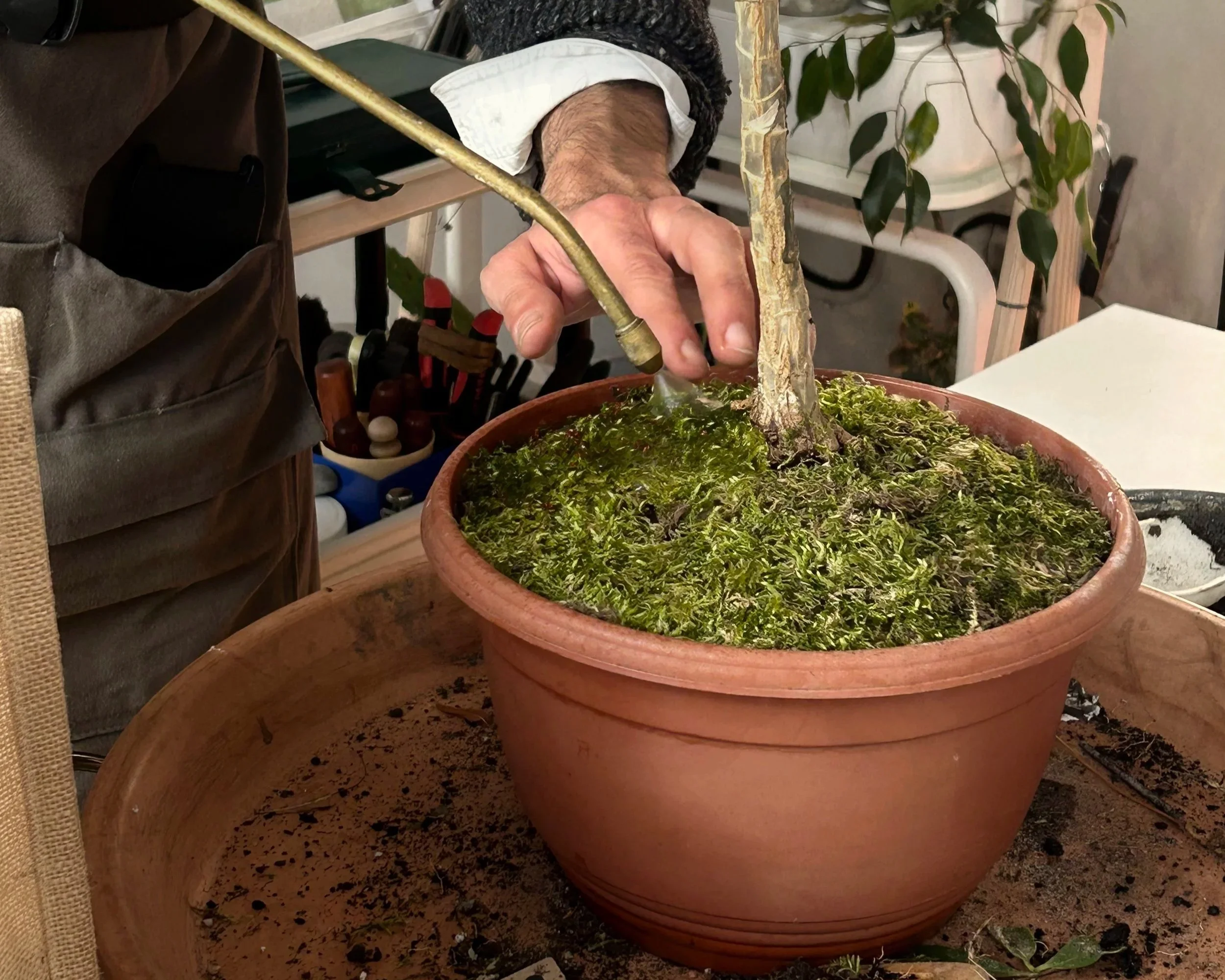
Living moss, where conditions allow, is a different experience. It works well in closed or semi-closed terrariums where humidity stays consistent, in shaded outdoor spaces with natural rainfall, and in north-facing positions where moisture can persist. On a smaller scale, moss can be used as a surface layer on the soil of houseplants, pressed gently around the base of the plant, it helps retain moisture, reduces surface evaporation, and adds a quiet, textural quality to the pot that no synthetic material quite replicates. It is one of the simplest ways to bring living moss into a domestic space without requiring the specific conditions of a full terrarium setup.
The Plant That Stays
Look closely at any neglected surface such as a garden wall, a roof edge, the base of a tree in a shaded courtyard and moss is usually already there, or on its way. It does not wait for an invitation. It moves into whatever gap the conditions allow, covering stone, concrete, bark, soil, with the same unhurried consistency it has maintained for nearly half a billion years.
What makes that persistence worth paying attention to is what it represents biologically. This is a plant with no vascular system, no roots, no flowers, one of the structurally simplest organisms on land and it underpins some of the most important ecological processes on earth: water regulation, soil formation, carbon storage, atmospheric monitoring.
It raises a genuine question: how often does something this consequential go unnoticed? And what else, at the margins of what we usually pay attention to, might be doing the same kind of quiet, essential work?
Glime, J.M. (2017). Bryophyte Ecology. Michigan Technological University. http://digitalcommons.mtu.edu/bryophyte-ecologyRydin, H. & Jeglum, J.K. (2013). The Biology of Peatlands. Oxford University Press.Harmens, H. et al. (2018). Mosses as biomonitors of atmospheric heavy metal deposition. International Journal of Environmental Research and Public Health. https://www.ncbi.nlm.nih.gov/pmc/articles/PMC6213074/IUCN (2021). Peatlands and Climate Change. https://www.iucn.org/resources/issues-brief/peatlands-and-climate-changeLoisel, J. et al. (2021). Expert assessment of future vulnerability of the global peatland carbon sink. Nature Climate Change. https://www.nature.com/articles/s41558-021-01251-2