
The Olive Tree: Icon of Resistance in Palestine
The olive tree (Olea europaea) is often described in botanical terms: drought-resistant, slow-growing, capable of living for centuries in poor, stony soil. Its silver-green leaves reflect harsh sunlight, its roots grip dry terraces, its trunk twists and thickens with age. In many regions of the Mediterranean, it is simply part of the landscape, but in Palestine, the olive tree is not just landscape, it is livelihood, memory, inheritance and, unmistakably, a symbol of resistance.
To speak about the olive tree in Palestine is to speak about time because some of the trees are said to be hundreds, even thousands of years old, they have outlived empires, borders, and political regimes. Their longevity is not a romantic myth but a biological fact: olive trees regenerate even when cut back; they send out new shoots from ancient roots. This capacity for renewal has made them agriculturally valuable for millennia, but it has also shaped their symbolic power, a tree that returns after being damaged becomes more than a crop, it becomes an emblem of persistence. The olive cultivation in Palestine is not marginal, It is central because many families rely on olive harvests for income, food, oil, soap, and trade. The harvest season is communal and intergenerational: grandparents, parents, and children gather beneath the same branches, nets are spread across the ground, hands move methodically from branch to branch, ladders lean against trunks carved by decades of wind and sun. The work is repetitive but meaningful, it ties people not only to the fruit of a single season, but to land that has been cultivated by their families for generations. In this sense, the olive tree functions as a living archive, it holds continuity in its wood and soil in its roots.
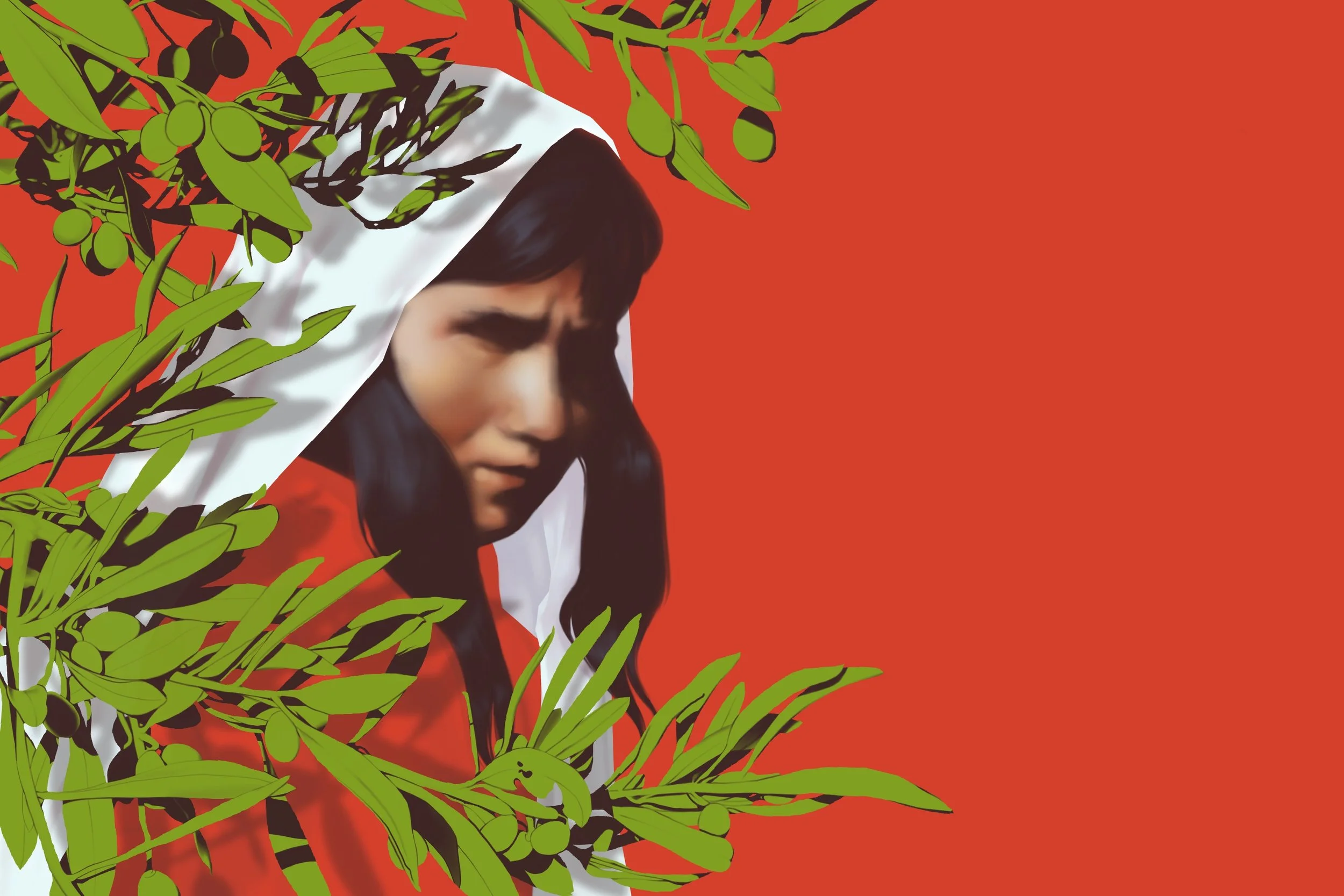
Art by Nadia Oettingen
It is impossible, however, to separate this agricultural reality from the political one. Olive groves in Palestine have been uprooted, burned, or restricted in access during periods of conflict. Trees that took decades to mature can be destroyed in hours and when that happens, the loss is not merely economic, it is symbolic and social. Removing an olive tree severs a link between family and land, between past and present, it disrupts both sustenance and story. In a context where land itself is contested, the act of planting, tending, or replanting an olive tree becomes charged with meaning, it becomes a declaration of presence. To acknowledge this is not to romanticize suffering, nor to instrumentalize a plant for rhetoric, it is to recognize reality, what happening in palestine is a genocide and not just palestinians recognise that, the international observers can see that to and they are not blind anymore by the big zionist media, even the reports from humanitarian organizations and global institutions document widespread destruction, displacement, and civilian casualties. Within this landscape of violence and instability, olive trees stand as witnesses, they are uprooted alongside homes and they are replanted as acts of defiance. Their image appears in murals, embroidery, poetry, and protest signs, this tree is now a language.
Yet the power of the olive tree does not lie only in symbolism, it lies in its material resilience. The bark is rough, often hollowed with age; branches grow at improbable angles; trunks appear split yet remain alive. Unlike ornamental plants cultivated for symmetry or perfection, olive trees are rarely visually pristine, they are scarred, irregular, and asymmetrical. Their beauty is not delicate, it is weathered and this physical character reinforces their metaphorical role, survival is rarely smooth, it leaves marks.
There is an ethical tension in writing about this subject from a distance. For those who do not live within the daily realities of occupation, bombardment, and displacement, the olive tree can easily become aestheticized, a poetic symbol detached from lived experience and that is precisely what must be avoided. The olive tree’s power lies in its embeddedness: in soil, in family labor, in contested land. Its symbolism is earned through material presence and repeated care, not imposed from outside. At the same time, symbols travel and the image of the olive branch has long represented peace in international iconography. In Palestine, however, the olive tree carries a more layered meaning: peace desired, land defended, identity maintained. It holds contradictions: vulnerability and strength, fragility and endurance and it can be burned, but it can also regrow, It can be cut down, but roots remain.
To look closely at an olive tree in Palestine, then, is to confront more than botany, it is to see how ecology and politics intersect. A tree that survives drought becomes a metaphor for a community surviving siege, a grove that is replanted after destruction becomes a quiet refusal to disappear. The olive tree does not shout, it stands, It grows slowly and insists on being rooted. In this sense, the olive tree is not only an icon of resistance, it is a practice of it. Resistance expressed not only through slogans or speeches, but through pruning, harvesting, pressing oil, and replanting saplings. Through the patient belief that land can still sustain life, through the refusal to abandon a tree that has grown alongside one’s family for generations.
In conclusion, to understand the olive tree in Palestine is to understand that plants are never neutral when land is contested, they become markers of belonging, they become targets, they become testimony, and in their quiet persistence, they remind us that resilience is not abstract, it is grown, season after season, in soil that refuses to forget.
