
Rot is Beautiful
There is a smell that stops people in their tracks.
Not the clean, antiseptic smell of a well-ordered kitchen. Not even the thin, floral scent of a candle. Something that rises from wet soil after rain, from a crock of fermenting cabbage left on the counter, from a compost pile on a warm morning when you lift the lid and a curl of steam meets your face. It is earthy, a little sharp, faintly sweet, and almost universally misunderstood.
Most people call it rot and it is one of the most sophisticated processes on the planet. What seems like the absence of life is, in fact, life reorganizing itself. When organic matter breaks down, it is being disassembled by an enormous, largely invisible workforce of bacteria, fungi, nematodes, and countless other organisms, each of them eating, excreting, dying, and becoming food in turn. The scientist Elaine Ingham, who coined the term "soil food web," spent decades mapping this underground economy and found something that sounds almost too poetic to be scientific: the living communities in a single tablespoon of healthy soil contain more individual organisms than there are humans on earth.
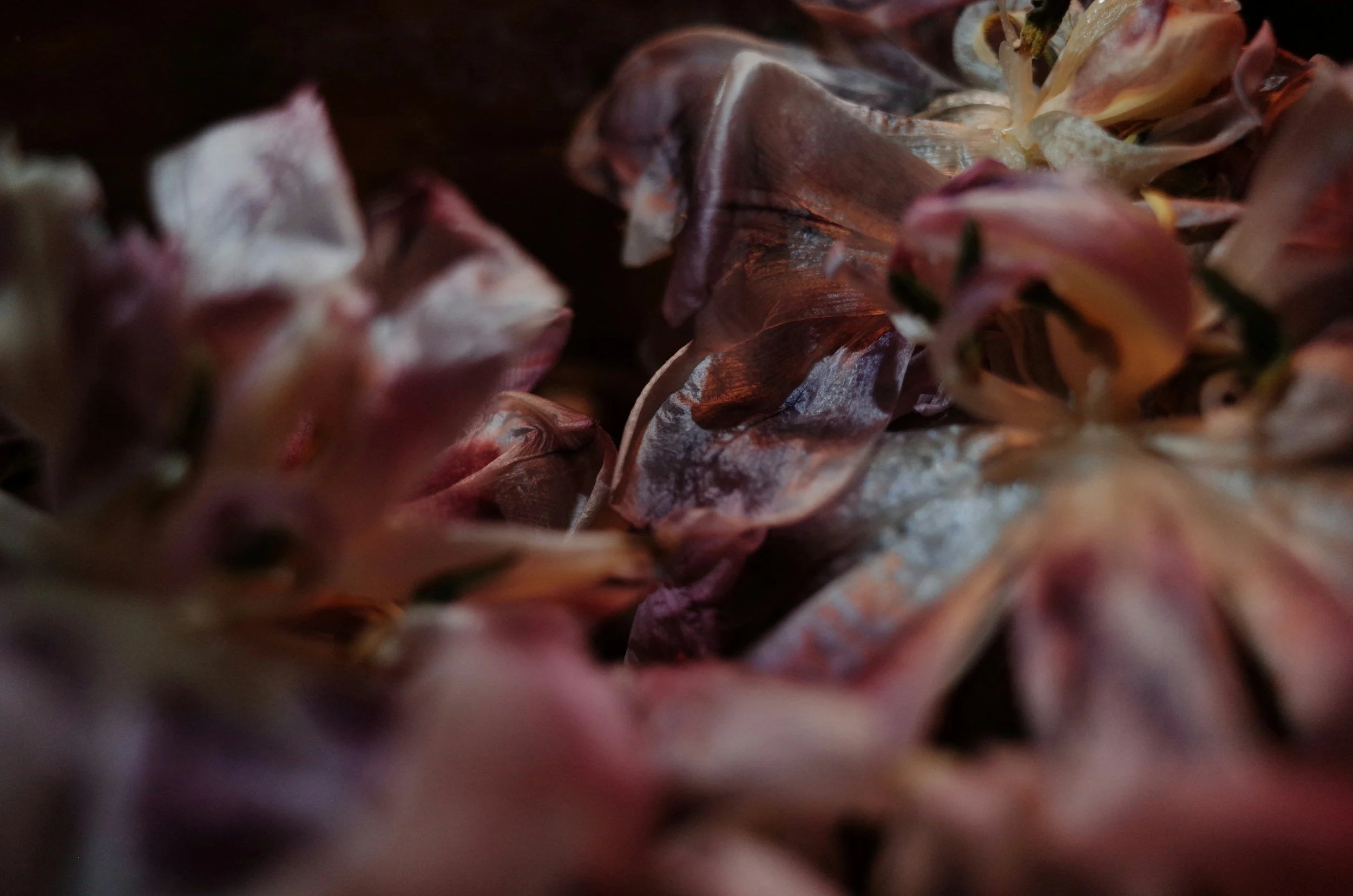
Somewhere along the way, not that hard to guess when, somewhere between the industrial revolution and the invention of the refrigerator, Western culture decided that decomposition was the enemy. We built systems to prevent it, contain it, mask it. We wrapped food in plastic, sterilized surfaces, and developed an aesthetic of cleanliness that equated visible decay with moral failure.
And yet every culture that has ever produced food worth eating has understood the opposite.
Korean grandmothers burying pots of kimchi in the earth to ferment through winter. The Roman garum, that pungent sauce made from fermented fish guts that flavored an entire civilization's cuisine. Sourdough starters passed between households like living heirlooms. Miso aging for years in wooden barrels. Every one of these traditions is built on the same insight: if you learn to work with decomposition instead of against it, you get something richer, more complex, and more alive than what you started with.
Sandor Katz, the writer who has probably done more than anyone alive to bring fermentation back into everyday kitchens, calls this "the transformative action of microorganisms." He does not frame it as a technique, but rather as a relationship, that requires attention, patience, and a willingness to let go of control over the outcome.
We could argue that the real work of plant growth happens underground, in darkness, driven by organisms most of us never see and rarely think about. In fact, if you feed your soil instead of your plant, that means if you add compost, introduce microbial life, and then step back, the soil will, in most cases, take care of the plant for you.
When you add a handful of vermicompost to a pot, you are not just delivering nutrients. You are introducing a community. The worm castings carry bacteria, fungi, protozoa, each of them adapted to particular roles in the cycle of breakdown and release. Within forty-eight hours, colonies are established. Fungal hyphae begin threading through the soil. The material that was, a few weeks ago, a coffee ground or a piece of cardboard or a wilted basil stem, has been transformed into something that will feed a root, which will feed a leaf, which will eventually fall and begin the whole cycle again.
We could think about this process as a jazz ensemble: each organism playing its own part, responding to the others, the whole thing producing something that none of them could produce alone.
There is a Japanese aesthetic concept called wabi-sabi that is often translated as "the beauty of imperfection." It is more accurate to say it is the beauty of impermanence, i.e. the crack in the ceramic that has been filled with gold, the moss growing over a stone wall, the way a persimmon looks just past its peak. Wabi-sabi looks directly at decay and finds there something that the pristine object cannot offer: evidence of time, of process, of change. Evidence of having been alive.
A freshly bought plant in a plastic nursery pot, in sterile commercial growing medium, is a product. It is optimized for display, for transport, for the moment of sale. It is, in a very real sense, paused, almost as if it is held in conditions designed to prevent the messy, dynamic, uncontrollable processes that make a living system actually live.
The moment you bring it home and put it in real soil with history, biology and the slight smell of earth after rain, something immediately shifts. This pause ends the plant enters a relationship with its environment and that environment, if you let it, will include decomposition. Dead leaves become food, old roots break down and feed new ones. The slow, patient cycling of matter through forms you cannot fully track or predict.
Now let’s talk about smell. The compound geosmin produced by aerobic bacteria in healthy soil is one of the most detectable substances we can smell. Humans can perceive it at concentrations as low as 9.5 parts per trillion. This is not a coincidence. Our sense of smell evolved in intimate proximity to soil, to fermentation, to the cycle of decay. The smell of good earth after rain is not incidentally pleasant: we are hardwired to recognize it as a sign of life, of a healthy and productive environment.
When a compost pile smells wrong, acrid, sulfurous, like something has gone badly off, that is also information. It means the system has gone anaerobic, the wrong organisms are dominating, something needs to change. Your nose knows the difference. It has been learning to make this distinction for hundreds of thousands of years.
Learning to let smell be a form of diagnosis, a way of staying in conversation with living processes is part of what it means to take decomposition seriously as a practice, not just a fact of biology.
The discomfort most people feel around decay is not really about smell, or mess, or the inconvenience of a compost bin under the sink. It is about something more fundamental. Decay is a reminder that things end. That matter is borrowed, not owned. That the tomato you grew and ate and composted is now, in some sense, the basil you will grow next spring, which is already the thing after that.
Plants do not need us to protect them from decomposition. They need us to understand it, to limit the sterilization of our soils, to prevent bagging our fallen leaves and to stop treating the slow dissolve of organic matter as a problem to be solved. When we do that, we do not just grow better plants. We step back into a cycle that was running long before we arrived, and will continue running long after we are gone.
And that cycle, patient, complex, largely invisible, smelling faintly of rain on warm earth, is, by any honest measure, extraordinary.
