
While You Sleep: Dreams, Plants, and What Happens in the Dark
There is a version of sleep that productivity culture is comfortable with. Eight hours, consistent schedule, no screens before bed, wake up restored and ready. Sleep as maintenance so that tomorrow you can perform better.
That version leaves out the part that has interested every culture before ours. That is the part where something else happens. Where the mind, freed from the management of daily life, goes somewhere and comes back with images that feel significant even when they make no sense, emotions that linger into the afternoon, a residue of somewhere that has no address.
Plants have not forgotten how to use the dark and neither have we.
What the Brain Is Actually Doing
Matthew Walker, a neuroscientist at UC Berkeley, spent years studying what happens to the brain during sleep and wrote about it in Why We Sleep (2017). During REM sleep, which is the stage most associated with vivid dreaming, the brain is nearly as active as it is during waking. The prefrontal cortex, which handles rational oversight and executive control, becomes quieter, meanwhile the regions associated with emotion, memory, and visual processing become louder. What emerges from this particular combination is a state in which emotional memories are processed without the chemical stress responses that accompanied them when they first occurred. Walker describes REM sleep as a kind of overnight therapy: the memory is retained, the acute pain of it is gradually reduced.
This is striking enough on its own. The mind uses the time when you are most helpless, most unconscious, most surrendered, to do some of its most delicate emotional work. The dream is a side effect of that process or perhaps a window into it.
The neuroscientist J. Allan Hobson, writing in The Dreaming Brain (1988), argued for a more mechanical account: that dreams are the cortex's attempt to make narrative sense of essentially random signals generated by the brainstem during REM. The story your dreaming mind tells is a confabulation, a best-guess interpretation of data that has no inherent meaning. This is a serious argument, and it has not been definitively answered. What it cannot explain is why the confabulations are so consistent and why the same symbols, the same landscapes, the same emotional logics recur across people who have never met, and across cultures separated by thousands of years.
The Long Record
The oldest written dream we have belongs to Gilgamesh. The Mesopotamian king, mourning his friend Enkidu, receives dreams that his mother interprets as prophecy, a falling star, a crowd gathering, an axe that the dreaming Gilgamesh embraces like a wife. The interpretive framework around them is entirely confident: dreams come from somewhere that knows more than the waking mind does, and the skill lies in reading them correctly.
A. Leo Oppenheim, an Assyriologist at the Oriental Institute of Chicago, in his 1956 study of Mesopotamian dream interpretation, documented the elaborate systems that existed for this purpose: tablets listing dream symbols and their meanings, professional interpreters attached to temples, incubation rituals in which a person would sleep in a sacred space specifically to receive a dream of significance. The Greeks had their own version: the sanctuary of Asclepius at Epidaurus was a site of therapeutic dreaming, where the sick would come to sleep and receive healing visions. The dream was understood as a diagnostic tool, a form of communication from a source that operated by different rules than daylight reasoning.
Freud secularised this intuition. The unconscious replaced the divine, the analyst replaced the priest, but the basic structure remained: there is something that knows things your waking self does not, and the dream is where it speaks. Jung pushed further, arguing in Memories, Dreams, Reflections (1962) that the imagery of dreams drew on a layer of the psyche shared across humanity, that is what he called the collective unconscious. The forest, the great tree, the underground passage, the figure at the threshold: these appear in dreams recorded across every culture and era because they are older than any individual or even civilisation. They are the mind's oldest vocabulary.
Calvin Hall was an American psychologist who believed that dreams could be studied empirically, the way any other behaviour could. He spent decades collecting them, more than 50,000 by the end, and found, when he analysed them systematically, that certain elements appeared with a regularity that defied coincidence. Landscapes, natural settings, vegetation, open terrain that required navigation. The dreaming mind, as it turns out, goes outside more than the waking mind often does. It returns to environments that the body has largely left behind.
What Happens When the Light Goes

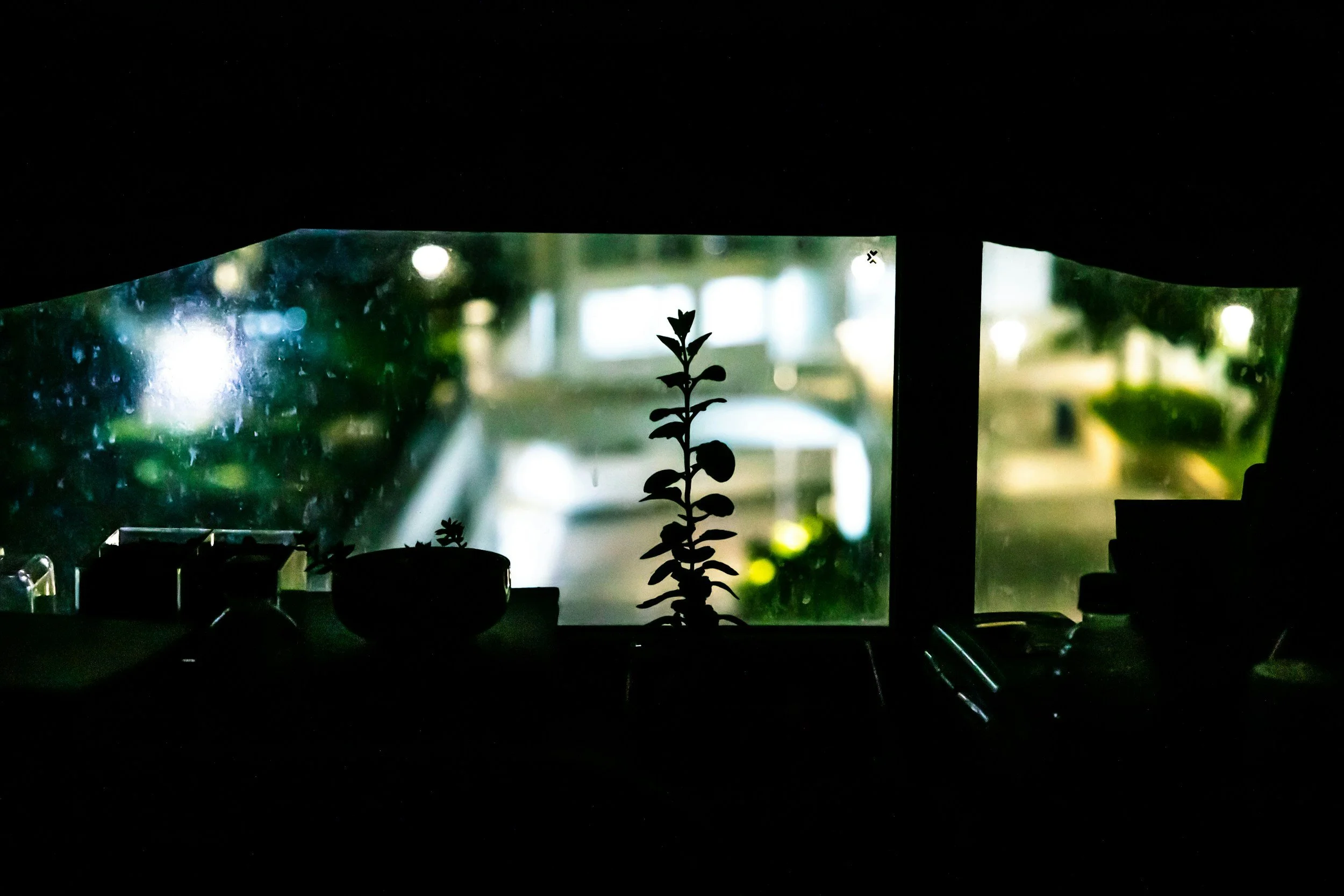
The sleeping mind turns inward, toward processes that run without oversight. So does the plant on your windowsill, and with the same indifference to whether anyone is watching.
During the day, stomata (the small pores on the surface of leaves) open to take in carbon dioxide and release oxygen. At night, in most plants, they close. The visible work of photosynthesis stops. But root activity often increases. The plant consolidates what it absorbed during the light hours, directing resources downward, extending its reach into the substrate, doing the structural work that growth requires but that happens out of sight.
Research on plant circadian rhythms, including work by Carré and colleagues, and studies from the Salk Institute's plant biology division, has established that plants have internal clocks that anticipate the transition between light and dark, beginning to adjust their physiology before the change actually arrives.
Both the sleeping mind and the plant at night are running the same basic logic: the visible work pauses, and the deeper work begins. The most important work, in the plant and in the sleeping mind, happens when observation is impossible. When no one is watching. When the organism has turned inward, toward the processes that maintain it and allow it to keep growing. What looks like stillness from the outside is nothing of the kind.
The Logic of Repetition
Some dreams come back. The same house, the same exam you have not studied for, the same coastline at the same moment before something happens. People who study this describe recurring dreams as the mind returning to unresolved material, emotional knots that have not yet been worked through, situations that still carry charge.
The spiral of a fern frond emerging from soil follows the same mathematical logic at every scale. The branching of a tree replicates itself from trunk to branch to twig to the veins of a single leaf. The pattern that governs the whole also governs the part. There is no level at which a different rule applies.
The recurring dream operates similarly. It is the mind returning to the same structure because something in that structure still has something to yield — the same way a plant returns to the same growth pattern season after season, refining it, going slightly further, following a logic written into it before it had any say in the matter. The image is a fractal. The root is a fractal. Neither one is stuck. Both are doing exactly what they are built to do, over and over, until the work is finished.
The Problem With Lucid Dreaming
Lucid dreaming, which is the practice of becoming conscious within a dream and exercising control over its content, has a dedicated following and a substantial literature. The appeal is understandable. The dream state is rich and vivid and largely beyond your control. The lucid dreaming project is to change that.
It is also, looked at directly, a very contemporary desire. The discomfort with surrender. The need to manage the experience rather than be subject to it. The same impulse that makes people anxious about eight hours of unconsciousness, about time passing without productivity, about the mind doing things the waking self did not authorise.
There is a version of plant care that works this way too. Hyper-managed, intervention-heavy, constantly monitored. And there is the other version, the one that understands that the plant has its own logic, its own timetable, its own requirements that have nothing to do with your schedule. That the best thing you can do, often, is establish the right conditions and then get out of the way. The dream, like the plant, does better when you are not trying to run it.
What Keeps Coming Back
Keats wrote Ode to a Nightingale in 1819, in a state somewhere between waking and sleep, trying to follow a bird's song into a space where time worked differently. The poem is about the border between ordinary consciousness and something older and wilder. The forest in the poem is where that other state lives. You can approach it but you cannot stay.
The forests in Calvin Hall's dream archive are not metaphors. They are the actual terrain of the sleeping mind, encountered night after night by people who have no particular reason to be dreaming about trees. They are there because something in the human mind still navigates by them, still uses the landscape of the non-human world as the setting in which the most serious inner events take place.
Jung called it ecological memory, in a sense, the idea that the collective imagery available to the dreaming mind includes forms and environments that predate cities, that predate agriculture, that go back to a relationship with the living world that the waking contemporary mind has largely abandoned but the sleeping one has not.
What connects them is not metaphor. It is the same structural fact: that the most important work happens outside of observation, outside of intention, in the hours that consciousness does not supervise. The plant does not choose to send its roots deeper at night. You do not choose what your sleeping mind decides to process or return to or finally let go of. Both of you are following something older and less negotiable than preference.
