
Growing Noise: What Music and Plants Have Always Known About Each Other
At some point, playing classical music to your houseplants became the kind of thing that gets mentioned at dinner parties as a charming eccentricity. Which means it has also become the kind of thing that is easy to repeat without thinking too carefully about what it actually means, or whether there is anything real behind it.
There is something real behind it. It is just not what most people think it is.
The relationship between music and plants is not primarily scientific. The connection is structural and cultural. Both music and plants exist in time, respond to the environment around them, and change the character of a space simply by being present in it. Beyond that, the language artists reach for when they want to talk about the hardest things (identity, loss, where you come from, what keeps you alive) is almost always the same language. Roots. Soil. Growth. Decay.
Playing Music to Plants: What the Research Actually Says
The most referenced piece of evidence for music affecting plant growth comes from a researcher named T.C. Singh, who conducted a series of experiments in India in the early 1960s. He exposed plants to classical music, including ragas played on traditional instruments, and reported accelerated growth, earlier flowering, and a physical lean toward the sound source.
The results were interesting. The methodology was not robust. Later researchers attempted variations, such as Beethoven, white noise, heavy metal, silence, and found inconsistent results that were difficult to replicate under controlled conditions. The popular summary that emerged from all of this, that plants love Mozart and suffer under loud guitars, is not supported by the evidence. It tells you more about the cultural assumptions of the people running the experiments than it does about plant biology.
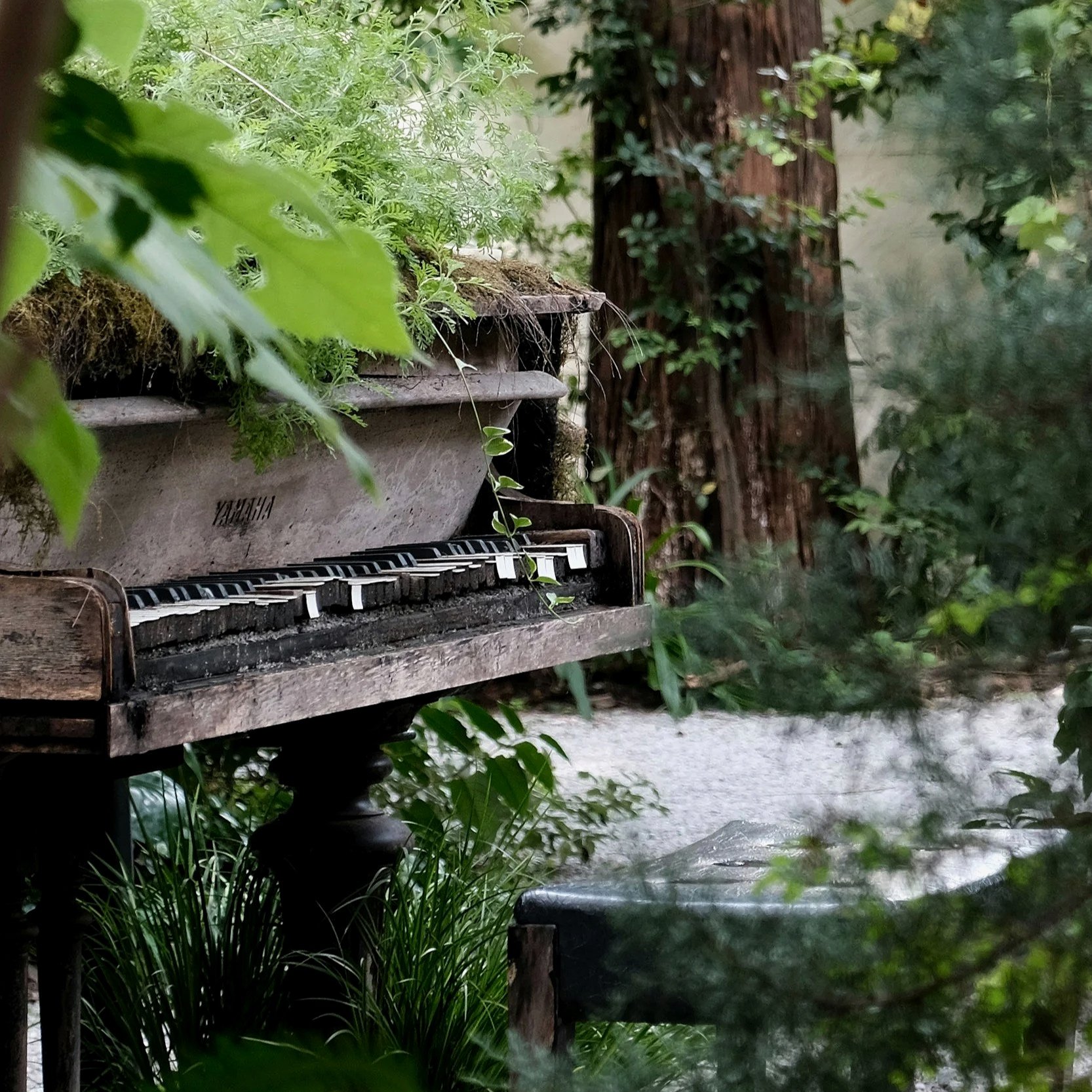
What the research does suggest, more cautiously, is that plants may respond to vibration at certain frequencies and that sound, as a physical phenomenon moving through air and substrate, can have measurable effects on germination rates and growth patterns under specific conditions. This is a genuinely interesting finding.
The more interesting question is not whether plants respond to Vivaldi. It is what the structure of music and the structure of growth actually share, and why we keep reaching for the comparison.
What a Forest and a Coltrane Solo Have in Common
Suzanne Simard is a forest ecologist who spent decades studying how trees in British Columbia communicate with each other. What she found, documented in Finding the Mother Tree, was a network of carbon transfer, chemical signalling, and fungal connection operating beneath the forest floor that had no conductor, no predetermined outcome, and no fixed tempo. It pulses. It responds. Older trees support younger ones through shared root systems. The whole system is rhythmic without being metronomic, organised without being controlled.
That is also, more or less, the logic of A Love Supreme. John Coltrane's 1965 quartet record is four movements, each responding to the last, built on a repeating motif that never appears exactly the same way twice. It develops the way a root system develops: by following what is already there, extending further, finding what it needs.
Certain kinds of music and certain kinds of growth actually organise themselves, non-linearly, responsively, through repetition that accumulates rather than merely repeats. Jazz improvisation, ambient music, and drone music all share these formal qualities. So does the way a plant fills available light, mycelium extends toward moisture, a forest recovers after fire.
The Room That Contains Both
Brian Eno is a musician and producer who has been shaping how we think about recorded sound since the 1970s. In 1978, he was hit by a car and spent a period of recovery lying still, unable to adjust a record player that was playing at a volume too low for normal listening. He lay there and heard the music blend with the ambient sound of the room (traffic, rain, the building) and realised he was hearing something he wanted to make deliberately.
The liner notes for Ambient 1: Music for Airports, recorded that same year, introduced the idea of music as environment rather than event. Something that could be ignored as easily as it could be attended to. Music that functioned the way light functions in a room: present, shaping everything, not demanding to be noticed.
That is also, almost exactly, how a well-placed plant works in a space.
You do not stare at it. You are not aware of it most of the time. But the room is different when it is there, in its quality, humidity, sense of being inhabited by something that is quietly alive. Both ambient music and indoor plants operate below the threshold of constant attention but above the threshold at which their removal would go unnoticed.
This is also a physical fact, not only an atmospheric one. Plants affect the acoustic properties of a room. Hard surfaces reflect sound; soft organic material, such as leaves, branches, the substrate of soil in a pot, absorbs it. A room with plants in it is a slightly different acoustic environment from the same room without them, in the same way that a furnished room sounds different from an empty one.
How Artists Use Plants to Say the Things That Are Hard to Say
Plant imagery in music carries a specific weight. Roots, soil, growth, and decay are not just decorative choices, they are ways of talking about ancestry, displacement, resilience, and what keeps you alive when conditions are against you.
Kendrick Lamar's To Pimp a Butterfly builds its entire structure around this kind of imagery: the caterpillar, the cocoon, the transformation, but also the fly-trap, the garden that might devour you, the soil that made something grow that was not supposed to survive. Nina Simone's Feeling Good moves through birds, rivers, trees, and open sky not as background scenery but as the actual substance of what liberation feels like. Nick Cave's The Boatman's Call returns again and again to growth that happens in darkness, to things that persist out of sight.
What these artists share is an understanding of what plant imagery can do that other language struggles to. It connects interior states to exterior processes. It insists that what is being described, whether it is identity, grief, resilience or love, is not only a feeling but a process. Something that unfolds over time, in conditions you did not choose, with outcomes you cannot fully control.
Weeds, Punk, and the Cost of Control
Punk happened partly because people got tired of music that was too managed. Too clean, too produced, too refined into a form that had no room for accident or genuine feeling. The argument was aesthetic and also cultural: that the process of control often removes the thing it was trying to protect.
Weeds make the same argument from every pavement crack, silently. A weed is a plant that grows without permission, without intervention, and often with more vitality than what was planted deliberately. The philosophy of rewilding, which means allowing degraded land to return to complexity by stepping back from management, is essentially the same position applied to landscape. Less intervention. More trust in what the thing wants to do if you leave it alone.
The most interesting claim in both cases is not that wildness is inherently better. It is the implicit critique of what control costs. What gets lost when the outcome is too tightly managed. A wall with moss growing into its cracks is not a failure of maintenance. It is evidence of something persisting on its own terms.
What They Both Know
Music and plants do not belong in the same conversation because of a scientific experiment. They belong together because both involve time, patience, and a quality of attention that does not require constant intervention. Both are changed by the spaces they occupy, and both change those spaces in return.
Put on a record. Sit near something green. It does not need to be more complicated than that.
Sources:
Brian Eno — Ambient 1: Music for Airports (1978) and Discreet Music (1975) / T.C. Singh — early research on music and plant growth (1962) / Suzanne Simard — Finding the Mother Tree (2021) / Alex Ross — The Rest Is Noise (2007) / John Coltrane — A Love Supreme (1965) / Kendrick Lamar — To Pimp a Butterfly (2015) / Nick Cave and the Bad Seeds — The Boatman's Call (1997) / Nina Simone — Feeling Good (1965)
